
 When you are planning your estate, concerns about lump-sum distributions can enter the picture. You may have a beneficiary with limited financial experience, or someone with a history of poor money management.
If you are in this situation, you will naturally have questions about limited long-term inheritance distributions. The good news is that there are steps you can take to create guardrails that will provide peace of mind.
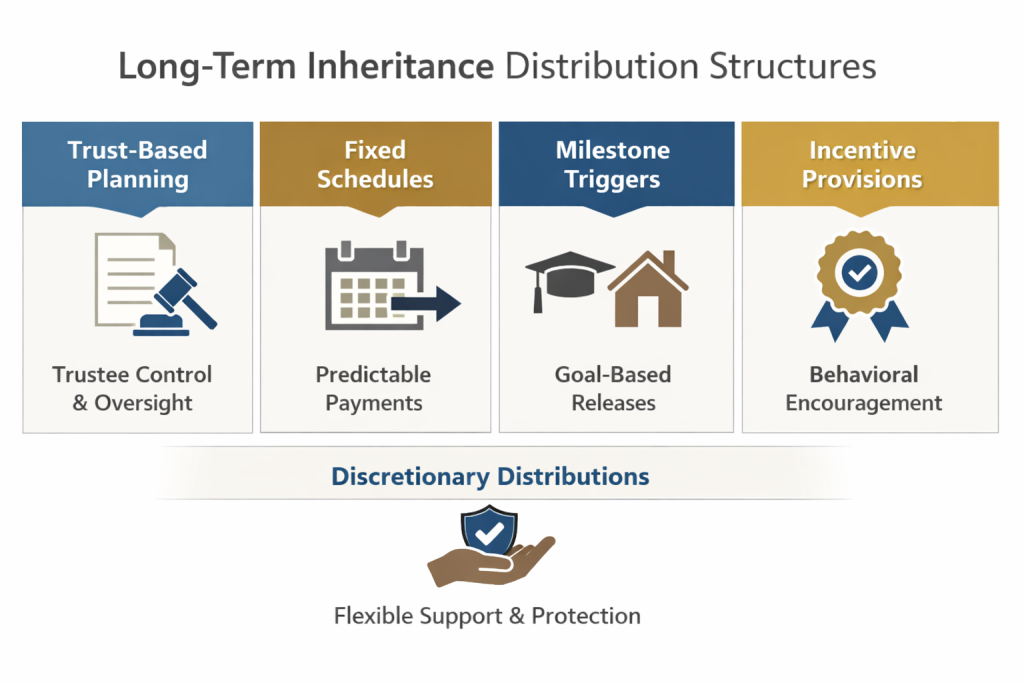
Trust Structures That Replace Lump-Sum Transfers
The most effective way to avoid a lump-sum inheritance is to change the legal path assets follow at your death. Instead of passing property outright to a beneficiary, you transfer those assets into a trust created as part of your estate plan.
Under this structure, the beneficiary does not receive immediate control of the assets. Authority over distributions shifts to a trustee, who must follow the instructions you set out in writing. This change is fundamental. Ownership and access no longer occur at the same moment.
Because the trust terms are legally enforceable, your instructions govern how the inheritance unfolds over time. That structure allows you to replace a single transfer with a long-term distribution plan that reflects your priorities.
Fixed Distribution Schedules Over Time
One straightforward approach involves fixed distribution schedules. Under this model, the trust releases assets in stages rather than all at once.
Distributions can be tied to specific ages or set intervals. For example, the trust may provide partial distributions every few years, with the balance held back until later in life. This pacing reduces the likelihood that assets will be exhausted early.
Fixed schedules work best when the beneficiary’s future circumstances are relatively predictable. Through careful drafting, the schedule can be customized to reflect maturity, responsibility, and anticipated financial needs.
Milestone-Based Distribution Triggers
Another option replaces calendar dates with life events. Instead of releasing funds at a certain age, the trust authorizes distributions when defined milestones are reached.
Common triggers include completing education, purchasing a primary residence, or reaching a stable employment threshold. These provisions allow assets to support progress rather than arrive arbitrarily.
Precision matters here. Each milestone must be clearly defined so the trustee can administer distributions without uncertainty. When drafted carefully, milestone-based distributions create structure without turning the trust into a checklist of vague aspirations.
Incentive-Based Distribution Provisions
Incentive provisions take milestone planning a step further by conditioning distributions on ongoing behavior. These terms can encourage financial responsibility while still providing meaningful support.
Incentives often relate to work, education, or health decisions. The trust may authorize distributions that supplement earned income or cover approved expenses tied to personal development.
Successful incentive planning requires balance. Conditions must be objective and measurable. Overly rigid incentives can backfire, while vague ones invite disagreement. Proper drafting keeps the focus on guidance rather than control.
Discretionary Distribution Authority
Life rarely follows a predictable script. For that reason, many long-term distribution plans include discretionary authority for the trustee.
Discretionary distributions allow the trustee to respond to changing circumstances within defined standards. Rather than relying solely on fixed rules, the trustee evaluates needs and authorizes distributions accordingly.
This flexibility is especially valuable when a beneficiary faces unexpected challenges or opportunities. By granting discretion within clear limits, you allow the plan to adapt without losing structure.
Selecting the Right Trustee for Long-Term Control
Distribution planning succeeds or fails based on who administers the trust. The trustee plays a central role in interpreting and applying your instructions over time.
You may choose an individual, a professional fiduciary, or an institutional trustee. Each option carries different strengths. Continuity, judgment, and administrative experience should guide your decision.
Because long-term trusts can last decades, trustee selection deserves careful attention. The right choice supports consistent decision-making and reduces the risk of disputes.
Asset Protection Through Controlled Distributions
Limiting access to inherited assets also provides meaningful legal protection. When a beneficiary does not control the trust assets outright, those assets are generally less exposed to outside claims.
This structure can reduce vulnerability to creditors and protect assets during divorce proceedings. The protection flows directly from the distribution design, not from secrecy or complexity.
By controlling how and when assets are distributed, you strengthen their ability to serve the beneficiary over the long term rather than becoming a short-term target.
Adjusting Distribution Terms Without Rewriting the Plan
Even the best-designed plan must account for change. Well-drafted trusts include mechanisms that allow adjustments without dismantling the entire structure.
These provisions may allow amendments under defined circumstances or grant limited authority to modify administrative terms. Flexibility is built into the document from the start.
Regular legal review remains essential. Rather than reacting to problems after they arise, periodic updates keep the distribution plan aligned with current realities.
Attorney-Led Drafting Is Key
Limited long-term inheritance distributions depend on precision. Boilerplate documents and generic language cannot account for the complexity involved in timing, conditions, and trustee authority.
Poor drafting creates ambiguity. Ambiguity leads to conflict, delay, and unintended outcomes. Clear, customized language allows the trustee to act confidently and the beneficiary to understand the rules.
By working with a licensed estate planning attorney, you translate your concerns into enforceable instructions. That professional guidance is what turns an abstract goal into a durable plan.
Thoughtful distribution planning allows you to provide support without surrendering control. Through proper structure, clear drafting, and informed trustee selection, you can shape how your legacy unfolds over time.
Long-Term Inheritance Distribution FAQs
Can you combine multiple distribution methods in a single trust?
Yes. In practice, many plans blend approaches. A trust may include a baseline fixed schedule, milestone-based distributions for larger releases, and discretionary authority to address unexpected needs. Combining methods allows you to maintain structure while preserving flexibility.
What happens if a beneficiary strongly disagrees with the distribution limits?
A properly drafted trust controls distributions regardless of disagreement. Because the trustee must follow the written terms, dissatisfaction alone does not override the structure. Clear drafting reduces the likelihood of disputes by setting expectations early.
Can limited distributions last for the beneficiary’s entire lifetime?
They can. Some trusts are designed to provide support over decades rather than transferring full control at a certain age. Lifetime trusts are often used when long-term asset preservation and protection remain priorities.
Does limited access mean the beneficiary cannot use the funds for emergencies?
Not necessarily. Discretionary provisions are often included specifically to address emergencies. When the trust grants the trustee authority to respond to changing circumstances, necessary support can be provided without abandoning long-term controls.
How does this type of planning affect taxes for the beneficiary?
Distribution structure influences how and when income is received, which can affect taxation. The details depend on the trust terms and the nature of the assets involved. This is one reason distribution planning and tax planning must work together during drafting.
Can a trustee be replaced if the relationship stops working?
Many trusts include removal and replacement provisions. These clauses allow a trustee to be changed under defined conditions without court involvement. Including this flexibility at the drafting stage prevents long-term administrative problems.
What if your concerns about the beneficiary change over time?
Estate plans are not static. While trusts are designed to operate long term, periodic legal review allows adjustments when circumstances evolve. Addressing changes proactively avoids rushed decisions later.
Is this type of planning only appropriate for large estates?
No. Distribution control is about behavior, timing, and protection, not asset size. Even modest estates can benefit from thoughtful distribution design when the goal is long-term stability rather than immediate transfer.
When should distribution planning be addressed during the estate planning process?
Distribution planning works best when it is addressed early. Waiting until documents are nearly complete often leads to compromises or oversimplified solutions. Early discussion allows the plan to be built around your priorities rather than added as an afterthought.
Take Action Today!
We can help you create a tailored plan that will facilitate distributions in the way that you see fit. If you are ready to get started, you can call us at 860-548-1000 to schedule a consultation at our Westport, CT estate planning office or our other location in Glastonbury.
You can use our contact form to send us a message, and you should head over to our seminar schedule page if you are interested in joining us at a complimentary learning event.

- Elder Law Answers: What’s the Connecticut Medicaid Asset Limit? - September 29, 2026
- Digital Estate Planning in the AI Age: Key Considerations - September 3, 2026
- A Medicaid Asset Protection Trust Can Bridge The Medicare Gap - August 25, 2026
 Estate Administration: Leave Instructions for Your Executor or Trustee
( By appointment only )